Thursday, December 27, 2007

Book Quote: Bluebeard by Kurt Vonnegut


"It was and remains easy for most Americans to go somewhere else to start anew. I wasn't like my parents. I didn't have any supposedly sacred piece of land or shoals of friends and relatives to leave behind. Nowhere has the number zero been more of philosophical value than in the United States." - Rabo Karabekian

Monday, October 22, 2007

Book Covers: The Eye In The Pyramid by Robert Anton Wilson


Book Review: The Pusher by Ed McBain

The third book in the 87th Precinct series is a more standard entry into the police procedural genre. But at the same time, it manages to reach an emotional depth somewhat unusual for the time period.

The plot is pretty straight forward. A pair of patrolmen stumble upon a apparent junkie suicide. But sometimes things aren't as easy as they seem, and the suicide squeal quickly turns into a multiple homicide investigation that threatens to become blackmail when Lt. Byrnes son becomes linked to the drug scene. The bulls at the 87th are relegated mainly to the footwork, as most of the behind the scenes action involves Byrnes as he struggles with his son's involvement. Byrnes goes as far as to fill Carella in on the situation, a decision that almost proves to be fatal.

Apart from some of the dated aspects one would expect from a well-reserched police drama from the fifties, the bulk of the novel is your typical expose on the brutal world of the street level drug trade. But as usual, McBain delves into the emotional causes and ramifications of the Heroin users and dealers. The most revealing of these is the personal and professional termoil faced by Lt. Byrnes with the revelation that his son is a Heroin addict. Adding to the emotional doubt of where he has gone wrong with his son, and the constant battle between anger and compassion, is the dilemma of whether or not to cover up his son's possible involvement in a crime, especially when a mysterious third party with knowledge of his son's connection attempts to blackmail him for police protection.

McBain doesn't just focus on the 87th detectives. Glimpses into the lives of low key players in the drug scene shows the many facets of human frailty and desperation and prevents the broad generalizations that many crime dramas easily fall into. Even the closer look at Carella's relationship with stoolie Danny the Gimp is both touching and revealing. But to McBain's credit, none of this detailed attention to the human element detracts from the gritty realism that is typical of this series.

Tuesday, October 16, 2007

Book Review: The Mugger by Ed McBain

McBain's second novel in the 87th Precinct series delivers an alternate to the straight mystery that started the series, setting the tone that his novels would switch back and forth betwee, and gives the main mystery a bizarre and darkly humorous twist.

In this case, a mugger that courteously bows and thanks the women he abuses and victimizes ("Clifford thanks you, Madam.") is terrorizing the city, and the bulls of the 87th doing their best to stop him. The pressure already on them increases when one of Clifford's apparent victims turns up dead.

With Carella on a honeymoon in the Poconos with his new bride Teddy, Willis and Havilland team up to track down the notorious Clifford. They are assisted in the search with the introduction of bald jokester Meyer Meyer, the most patient man in the 87th. Also introduced is female detective Eileen Burke, who goes undercover as Clifford bait in a desperate attempt to trap the mugger.

At the same time, patrolman Bert Kling finds himself stepping out of bounds as he looks into the murder of an old friend's daughter, who just happens to be Clifford's homicide victim. His private investigation threatens to endanger his job, but also puts him in contact with the dead girls beautiful college friend, whom he falls for instantly.

The Mugger is one of McBain's less spectacular stories, by which I mean it is not the crimes themselves that keep you riveted, but the characters involved and the stories they tell. A good portion of the book is taken up by interrogation transcripts, but they give a deeper feeling to the city and its denizens rather than bog it down.

Monday, October 15, 2007

Amongst Friends

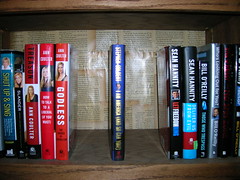
It is the strangest thing. No matter where I place Stephen Colbert's latest book, I Am America, in the Right Wing section of my political book shelf, they always end up looking like this in the morning.

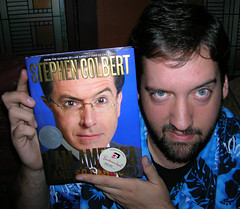
I Am America As Well

Despite my natural revulsion at the thought of actually paying retail for books, I managed to choke down my disgust long enough to purchase my own copy of Stephen Colbert's I Am America.

I strongly suggest you do the same.

Sunday, October 14, 2007

Book Review: Cop Hater by Ed McBain

I've never been a fan of police procedurals. The majority of them tend to be more concerned with showing off the author's knowledge of obscure investigation technique trivia than telling any kind of cohesive, let alone down to earth, story. With this in mind, the only reason I offer for loving the 87the Precinct series, written by the man who practically invented the genre, is that he writes it better than anyone else. If you're sick and tied of the Law & Order clones, maybe you should take a step back and check out the series that defined the genre and has yet to be surpassed. And if you've never visited McBain's series, then there is no better place to start than the beginning.

Cop Hater is an able and worthy introduction to the world of the 87th Precinct's Homicide Division, walking the beat of its fictional city for over fifty years, right up until the author's death last year. Many book series suffer from weak openings and fluctuations in quality and style that often leave fans recommending later entries as a starting point for new readers. The 87th never felt any such growing pains, and Cop Hater still stands as strong as the 53 that soon followed.

Detective Carella, the anchor of the series, is introduced in this initial outing, along with other long-term cast members including his love interest and future wife Teddy, stoolie Danny the Gimp, Lt. Byrnes, hack journalist Savage, Bert Kling (still a patrolman before earning his detective's badge in The Mugger), angry bull Roger Havilland, and the diminutive but dangerous Hal Willis.

Cop Hater is one of McBain's more direct titles, and covers the plot simply. Someone is killing cops out of the 87th Precinct. A dead cop is always taken seriously by other cops, but things become personal for Carella when the third officer gunned down in cold bloody is his partner Bush, and even more so when newspaper reporter Savage turns his deaf girlfriend Teddy into a prospective target. With nothing more to go on than the killer's motive as a Cop Hater, the race is on to catch the killer before he kills anyone else that Carella cares for, or for that matter. Carella himself.

Many police procedural series try to over-the-top with spectacular crimes or completely outrageous twists and turns, and mind-numbingly technical procedure descriptions. This is territory that where the 87th Precinct never strays into. While McBain does take the time to explain how and why certain aspects of the job are undertaken, he does so not to flog the reader with facts, but to help them understand exactly what the bulls of the 87th are up against. The crimes and characters of the 87th are always believable, interesting, and never fail to ring with a truth and honesty that makes it seem as real as crime in your local papers. Cop Hater embodies this truth as much as any of the other books, despite being written over fifty years ago. The procedures may change over time, but the criminals are cops are still driven by the same beliefs.

The Tax Man Reporteth


It will be very interesting to here the spin coming from both sides on this come Monday morning...

NEW YORK (Reuters) - The richest one percent of Americans earned a postwar record of 21.2 percent of all income in 2005, up from 19 percent a year earlier, reflecting a widening income disparity among different classes in the nation, the Wall Street Journal reported, citing new Internal Revenue Service data.
The data showed that the fortunes of the bottom 50 percent of Americans are worsening, with that group earning 12.8 percent of all income in 2005, down from 13.4 percent the year before, the paper said.


Now to be fair, later in the article, numbers about the top 1% show that "the wealthiest, as a group, carried a disproportionate share of the overall tax burden -- 1.6 percent of all taxes, versus just 1.1 percent of all income." But since this report deals mainly with the Tx Man's AGI (Adjusted Gross Income) scale, what isn't factored into accumulated wealth owned. To give you an idea of the difference this makes, consider that in order to make the top 1% of wage earners, of which there are only 400, the bar you have to clear for a declared income is an AGI of $364,657. To make the top 5%, all you need is an AGI of $145,283.

Of course the Times article closes with this little gem:

(New York Times, 10,14) A second report that the I.R.S. will make public today shows that the number of Americans with high incomes who pay no taxes anywhere in the world has reached a record. In 2000, there were 2,022 Americans with incomes of more than $200,000 who paid no income tax anywhere in the world, up from just 37 in 1977, when the report was first issued.

Which means that there are five times as many wealthy wage earners not paying any taxes at all then there wage earners in the top 1%.

I might have missed it, but nowhere in the report could I find whether or not the tax dodgers and their 0% of paid taxes was figured into the percentage of taxes paid by the top 5%.

Sunday, October 7, 2007

Book Cover of the Day: .357 Vigilante #1

Book Review: 5 Novels by Daniel Pinkwater

To this day, I can not fathom the popularity of Harry Potter or the Chronicles of Narnia. Many might try to blame this on my age, or a lack of love for fantasy or adventure. The truth, however, is because I grew up reading books by authors like Daniel Pinkwater, and have since then passed up the painfully melodramatic in preference of the touchingly absurd.

This collection of young adult fiction by Daniel Pinkwater offers a generous sampling of the author's favorite subject matters. Aliens, misfits, weird people, rebellious students, and fat men all have places of honor among these tales.

In Alan Mendelsohn, Boy from Mars, Leonard Neeble is such an outcast at school that even the nerds make fun of him. Just when he's given up hope on ever being happy, along comes Alan Mendelsohn, a new kid who seems to enjoy annoying teachers and blowing off the cool kids. Leonard and Alan become quick friends, and in no time at all Alan is showing Leonard how to skip school, smoke cigars, lift objects with his mind, contact alien races, and learn to enjoy who he is without the approval of others.

Slaves of Spiegel, simply put, is about a race of fat people that forces other races into a cooking contest, while The Snarkout Boys are a group of young lads who "snark out" at night and have many bizarre adventures. The Last Guru, is about, well, the last guru. Go figure.

My personal favorite, however, and the grand example of Daniel Pinkwater's bizarre brand of genius, is Young Adult Novel. The story revolves around Wild Dada Ducks, a self-proclaimed dadaist group consisting of Charles the Cat, the Honorable Venustiano Carranza (President of Mexico), The Indiana Zephyr, Captain Colossal, and Igor. They spend their time performing dadaist plays and acts of pointless revolution at their high school, and writing parody young adult novels featuring the fictional character Kevin Shapiro. But when they discover that there actually is a student in the school named Kevin Shapiro, they immediately take him under their wing despite his protests, ignorant to the possibility that their own creation might rebel against them. After all, that is dada.

Very few children's authors, past or present, can successfully inject this much original wackiness into their stories while simultaneously teaching much needed life lessons that many books never touch on. Granted, not all of his young adult novels are meant to inform, but even the ones meant purely for entertainment can't help but leave you feeling better for the experience. Children, young adults, and even some grownups could do with a little Pinkwater influence.

Thursday, October 4, 2007

Book Review: The Sociopath Next Door by Martha Stout

These days, with the abundance of books, movies, and television programs available on demand for instant entertainment, our knowledge tends to be informed by popular culture rather. Because of this,our intake of the dramatic simplification of most topics is outweighed drastically by factual representation.

With this in mind, it is no wonder that most of us envision dangerous people as wild-eyed lunatics noticeable a mile way, disheveled madmen that are encountered far and few between.

As Martha Stout demonstrates in The Sociopath Next Door, there are people capable of unimaginable atrocities all around us, and not only do they appear like everyone else, but they might even be less conspicuous than one would hope.

If Good and Evil are opposites of the same coin, and Good people are those who care and feel for others, then it stands to reason that evil exists as people lacking the ability to care or love. These people exist, cold and calculating sociopaths unfettered by the restrictions of guilt or conscious, and they do so in alarming numbers reaching epidemic proportions. 4% of the US population are afflicted with Sociopathic Personalities, far greater than those afflicted with cancer. Meaning one out of every twenty-five people you meet feel no remorse or regret, and are capable of anything.

Martha Stout's book strikes an elegant balance between clinical facts and anecdotal examples, making this book an easy read that manages not to come off as either a fluffy fear-mongering diatribe or a stuffy jargon-laden medical tome. The examples created from personal case studies perfectly illustrate the points of each chapter, but don't detract from the factual or philosophical topics discussed.

Despite chapters warning of the realities of the sociopaths among us, such as their alarming ability to blend in and even charm us into their confidence, her tone never reaches an alarmist level. This is a book that informs and prepares, with instilling false hope or blind panic in its audience. Also, while this topic is heavy with emotion, Stout never descends into supermarket tabloid prose. Apart from a slight detour into 9/11, which almost has no bearing on the topic at hand, the examination of the origins and ramifications of the human conscious remain informative and exploratory without becoming preachy. Especially interesting is the chapter that delves into the nature vs. nurture debate, in which she examines the genetic, environmental, and cultural influences that can help create or subdue a growing child's sociopathic tendencies.

If you have ever witnessed someone behaving extraordinarily ruthlessly or cruelly, and have wondered how someone could even bring themselves to act in such a manner, this book will go a long way towards satisfying your curiosity.

Book Cover of the Day: Bread